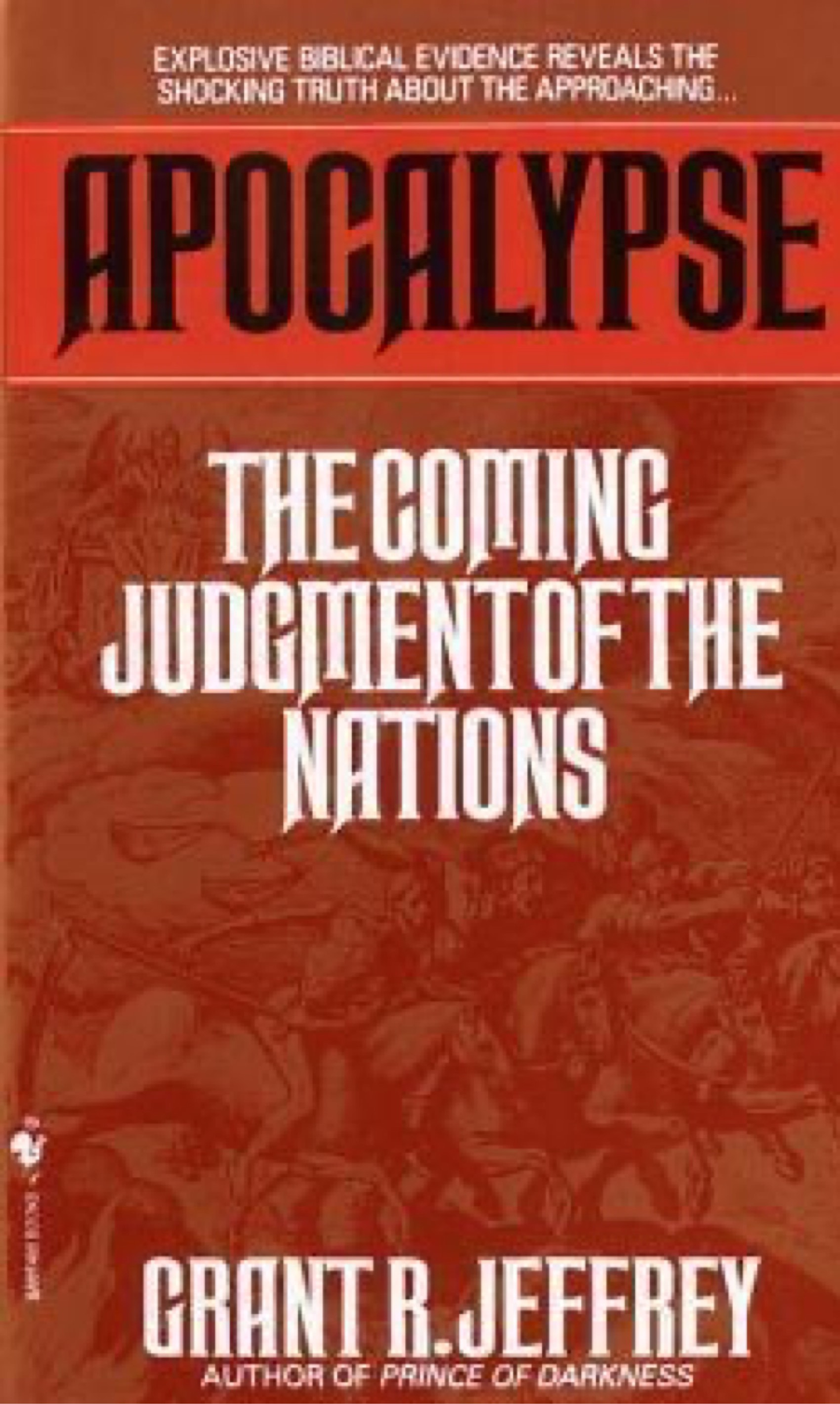
Apocalypse: The Coming Judgment of the Nations
📖 Summary of Apocalypse: The Coming Judgment of the Nations by Grant R. Jeffrey
Apocalypse: The Coming Judgment of the Nations is Grant R. Jeffrey’s detailed interpretation of the Book of Revelation and biblical end-times prophecy. First published in 1992, the book presents Revelation from a strongly futurist, literalist, premillennial, and pre-tribulation perspective. Jeffrey says his study of Revelation convinced him that the coming Kingdom of God is the ultimate goal of human history.
The book’s central argument is that most of Revelation describes real events that will occur near the end of the present age, rather than events already fulfilled in the destruction of Jerusalem in AD 70 or merely symbolic descriptions of the struggle between good and evil. Jeffrey believes biblical prophecy should normally be interpreted literally, although symbols in Revelation represent literal realities.
🔎 How Jeffrey Interprets Revelation
Jeffrey discusses several approaches to Revelation but adopts the futurist interpretation. He rejects the preterist or “Kingdom Now” approach that places most of Revelation in the first century, as well as interpretations that treat its prophecies primarily as allegories. For Jeffrey, Revelation points toward a future Great Tribulation, Antichrist, Armageddon, Second Coming, and literal millennial reign of Christ.
He also argues that the early Christian church originally expected Christ to return before a literal thousand-year kingdom, making premillennialism, in his view, the earliest Christian understanding of prophecy. The book therefore presents itself not simply as speculation about the future but as a recovery of what Jeffrey regards as the original Christian interpretation of Revelation.
✝️ The Rapture Before the Tribulation
A major part of the book concerns the Rapture of the Church. Jeffrey distinguishes the Rapture from Christ’s later public return to earth.
According to his interpretation, before the seven-year Tribulation begins, living Christians will be caught up to meet Christ, while deceased believers will be resurrected. Jeffrey emphasizes that the deeper purpose of the Rapture is not simply escape from the Tribulation but the transformation of believers into immortal, incorruptible resurrection bodies.
He therefore understands Christ’s Second Coming as involving two related but distinct events: first, Christ comes for His Church in the Rapture; seven years later, Christ returns publicly with His saints to defeat His enemies and establish His kingdom.
👤 The Antichrist and the False Prophet
Jeffrey expects the rise of a literal Antichrist during the final period of human history. The Antichrist will become a powerful political ruler associated with a global system of government.
Alongside him will appear the False Prophet, a religious figure who supports the Antichrist and encourages humanity to accept his authority.
For Jeffrey, these are not merely symbols of evil governments or institutions. They are actual future personalities who will play central roles in humanity’s final rebellion against God.
🐎 The Seven Seals and the Great Tribulation
The opening of the seven-sealed scroll begins a terrifying sequence of divine judgments. Jeffrey interprets the Four Horsemen and subsequent catastrophes as future realities involving warfare, famine, death, persecution, and enormous human suffering.
He explicitly identifies these disasters as manifestations of God’s wrath, arguing that Christ Himself releases the judgments by opening the seals. Because Jeffrey believes Christians are promised deliverance from divine wrath, this becomes part of his argument that the Church must be raptured before these judgments begin.
At the same time, Jeffrey believes many people will turn to God during the Tribulation. He discusses the 144,000 Jewish witnesses, the Two Witnesses, angelic proclamations, and large numbers of Jewish and Gentile believers who suffer martyrdom during this period.
🐉 War in Heaven and Satan’s Final Struggle
Behind the political and military events on earth, Jeffrey sees a much larger spiritual conflict between God and Satan.
Revelation’s imagery of Michael fighting the dragon represents this cosmic struggle. Jeffrey emphasizes that Revelation itself identifies the dragon as Satan, illustrating his principle that biblical symbols point toward genuine spiritual realities.
The conflict that has existed throughout human history therefore reaches its climax during the Tribulation.
🏛️ The Mystery of Babylon
Jeffrey devotes considerable attention to Babylon, distinguishing aspects of religious and political-economic Babylon in Revelation.
Babylon represents a final rebellious world system opposed to God. Its destruction becomes part of the collapse of human civilization immediately before Christ’s return.
Thus, Revelation is presented as not merely predicting isolated disasters but describing the destruction of an entire world order that has placed political power, wealth, human pride, and false religion above God.
⚔️ Armageddon and the Judgment of the Nations
The Tribulation culminates in the Battle of Armageddon and what Jeffrey calls the coming judgment of the nations—the idea reflected in the book’s subtitle.
Christ then returns visibly and triumphantly. Unlike the Rapture, which Jeffrey considers an event involving the Church, Christ’s Revelation in glory will be witnessed by the world. Christ returns to defeat the Antichrist, destroy the armies opposing Him, imprison Satan, and establish His kingdom on earth.
The Second Coming therefore forms the decisive turning point of the book: human rule gives way to the direct rule of the Messiah.
🇮🇱 Israel and Biblical Prophecy
Israel occupies an especially important place in Jeffrey’s end-times system. He rejects the idea that God’s promises to Israel have been permanently transferred to the Church.
Israel’s national restoration and Jerusalem therefore have prophetic significance. Jeffrey believes God’s covenants with Abraham, Isaac, and Jacob remain valid and that Israel will have a special position during the future Messianic kingdom. He even maintains that Israel will continue its distinctive role beyond the Millennium into the New Earth.
🕵️ The Ten Lost Tribes of Israel
This leads Jeffrey into the fascinating question discussed in our earlier article: What happened to the Ten Lost Tribes?
The book contains an entire chapter titled “In Search of the Ten Lost Tribes of Israel,” showing that Jeffrey regards their survival and eventual restoration as part of the larger prophetic story. It appears alongside chapters on Israel, the judgment of the nations, and the Millennium in the book’s overall progression.
Within that discussion, Jeffrey considers possible surviving Israelite populations, including the Pathans/Pashtuns of Afghanistan and Pakistan, while stopping short of claiming that their Israelite ancestry has been conclusively demonstrated.
👑 The Millennium
Following Christ’s victory comes the Millennial Kingdom—a literal thousand-year reign of the Messiah on earth.
Satan will be restrained, Christ will rule the nations, and the saints will reign with Him. Israel will occupy its promised position, and Jerusalem will become central to the Messianic order.
For Jeffrey, the Millennium represents God’s answer to thousands of years of failed human government: humanity’s kingdoms ultimately give way to the Kingdom of the Messiah.
🔥 Satan’s Final Rebellion and the Great White Throne
Jeffrey does not regard the Millennium as the end of the story.
After the thousand years, Satan is released and leads one final rebellion. God defeats this rebellion permanently, and Satan is cast into the lake of fire.
Then comes the Great White Throne Judgment, which Jeffrey places after the Millennium. All the unbelieving dead throughout human history are resurrected and judged. This judgment demonstrates, in Jeffrey’s theology, both God’s justice and the ultimate defeat of evil.
🌆 The New Jerusalem and the New Creation
The final chapters move from catastrophe to restoration.
Jeffrey describes the New Jerusalem, eternal life with God, and ultimately the creation of a new heaven and new earth. The present creation, corrupted by sin, is replaced by a purified creation in which the consequences of humanity’s rebellion have finally disappeared.
This means the book is ultimately not intended to end with Armageddon or destruction. Its destination is Paradise restored.
🌅 The Book’s Overall Message
The whole argument can therefore be understood as a prophetic sequence:
Church Age → Rapture → Antichrist → Seven-Year Tribulation → Divine Judgments → Armageddon → Second Coming of Christ → Judgment of the Nations → Restoration of Israel → Millennial Kingdom → Satan’s Final Rebellion → Great White Throne Judgment → New Jerusalem → New Heaven and New Earth.
Jeffrey’s fundamental message is that Revelation is ultimately about the victory of Jesus Christ rather than the victory of the Antichrist. The frightening judgments occupy only one stage of a much larger story: God defeats evil, restores Israel, judges the nations, establishes the Messiah’s kingdom, abolishes Satan’s power, and finally restores creation.
In Jeffrey’s own framing, Revelation is the “Revelation of Jesus Christ”—an unveiling of Christ’s nature, triumph, authority, and final victory. Its ultimate purpose is to reveal God’s plan to redeem the earth from sin through the triumph of Christ over Satan and the Antichrist.
Thus, despite its dramatic title, Apocalypse: The Coming Judgment of the Nations is fundamentally a book about Jeffrey’s premillennial vision of how human history ends: not with permanent catastrophe, but with the triumph of the Messiah and the restoration of Paradise.