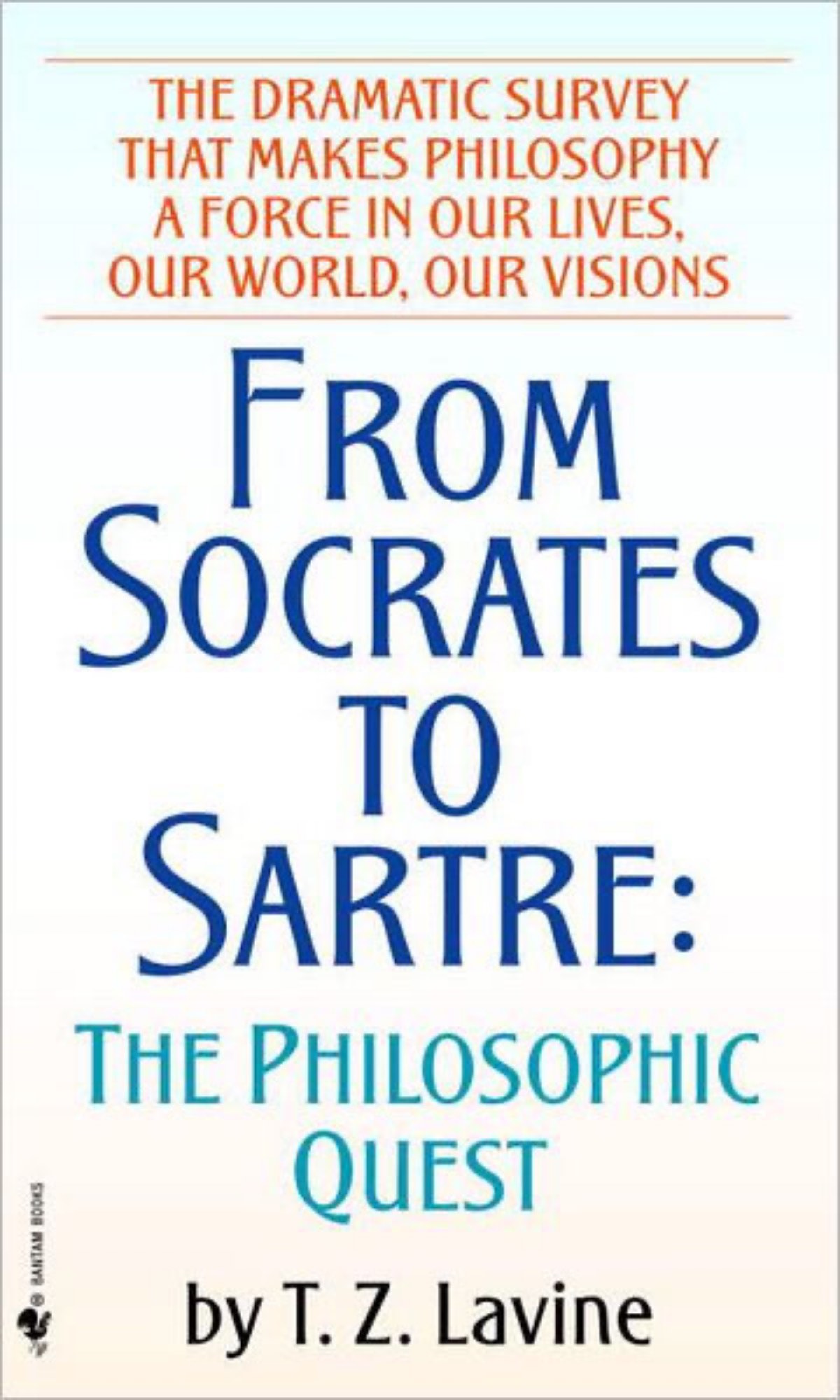
From Socrates to Sartre
📚 Author: T. Z. Lavine — A Brief Life Summary
T. Z. Lavine (Thelma Z. Lavine) was an American philosopher and educator who served as Elton Professor of Philosophy at George Washington University. She earned her Ph.D. from Harvard University and received several academic distinctions, including a philosophy research fellowship and the Josiah Royce Fellowship. Beyond writing books and scholarly articles, she became widely known for presenting philosophy in an accessible way through her educational television series From Socrates to Sartre, which later became part of university curricula.
Her work focused on making difficult philosophical ideas understandable to ordinary readers and students. Rather than treating philosophy as abstract theory alone, she emphasized its connection to human life, society, politics, and civilization.
📖 Summary of From Socrates to Sartre: The Philosophic Quest
From Socrates to Sartre is a broad introduction to the history of Western philosophy, tracing the development of major philosophical ideas from ancient Greece to modern existentialism. The book explores enduring questions that humanity continually asks:
* What is reality?
* What can human beings truly know?
* Why should we be moral?
* What is the best form of government?
* Does history have meaning?
Lavine examines the ideas of several major philosophers:
* Plato — truth, justice, ideal society, and the theory of Forms.
* René Descartes — reason, certainty, and “I think, therefore I am.”
* David Hume — skepticism and empirical knowledge.
* Georg Wilhelm Friedrich Hegel — history, dialectics, and human development.
* Karl Marx — class conflict and social transformation.
* Jean-Paul Sartre — freedom, responsibility, and existentialism.
The central message of the book is that philosophy is not merely a collection of theories; it is humanity’s continuing search for truth and meaning. Lavine argues that philosophical questions never disappear because they arise from the human condition itself. Without philosophy, human life risks becoming mechanical and unreflective.
In one sentence: the book presents philosophy as a living journey through humanity’s deepest questions, from the ancient world of Socrates to the modern world of Sartre.