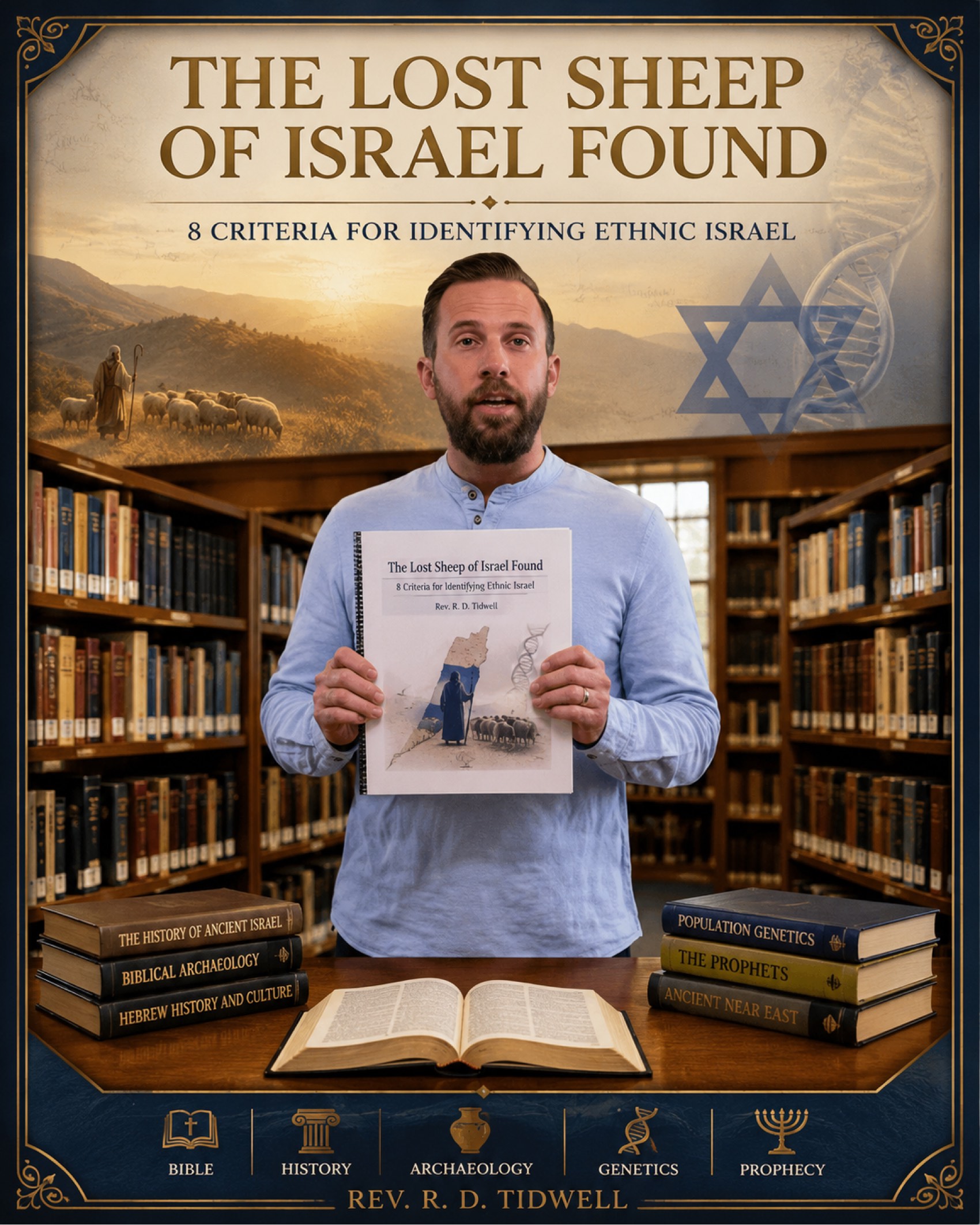
The Lost Sheep of Israel Found
Summary of The Lost Sheep of Israel Found: 8 Criteria for Identifying Ethnic Israel
By Rev. R. D. Tidwell
This paper presents a two-part theological and historical argument concerning the identity of biblical Israel.
Part I: The Edomite Hypothesis
The author argues that many of the political and religious leaders associated with the modern State of Israel are not biological descendants of the tribe of Judah but are instead descended from the ancient Edomites (Idumeans), who were forcibly converted to Judaism during the Hasmonean period under John Hyrcanus. Historical sources such as Josephus are cited to support this reconstruction.
The paper further contends that:
* Herod the Great, an Idumean, illustrates how Edomite rulers came to govern Judea.
* References such as Revelation 2:9 and 3:9 (“those who say they are Jews and are not”) are interpreted as referring to this group.
* Modern Jewish populations are argued to have significant continuity with Levantine populations, but the author maintains that this does not establish direct descent from biblical Israel.
* The modern establishment of Israel in 1948 is presented as a political rather than prophetic restoration, with the true biblical restoration reserved for the return of the Messiah.
⸻
Part II: The Lost Sheep Found
Having argued that today’s Jewish population does not represent ethnic Israel, the paper asks:
Where are the biological descendants of Jacob today?
The author proposes identifying them through eight biblical and empirical criteria, combining:
* biblical prophecy,
* ancient history,
* archaeology,
* linguistics,
* and population genetics.
The paper begins by discussing Y-chromosome (Y-DNA) haplogroups and ancient DNA studies, arguing that:
* Haplogroups common in the ancient Levant are associated with Canaanite populations.
* Certain Haplogroup R lineages found at ancient Levantine archaeological sites are interpreted as representing early Israelites.
* The author therefore proposes that many populations of northern and western Europe carrying Haplogroup R may preserve significant paternal ancestry from ancient Israel.
⸻
The Eight Criteria
The proposed criteria are intended to identify ethnic Israel by requiring that a candidate population satisfy multiple biblical and historical characteristics simultaneously. These include:
* remaining genetically distinct from surrounding Canaanite populations,
* exhibiting migration patterns consistent with the Assyrian exile,
* matching biblical descriptions of Israel’s later dispersion,
* and corresponding with ancient DNA evidence recovered from archaeological sites.
⸻
Central Conclusion
The paper concludes that:
* the ruling class in modern Jerusalem should not be identified with biblical Judah;
* the descendants of Jacob remain dispersed among European populations, particularly those associated with Haplogroup R;
* these descendants have largely forgotten their identity (“lost sheep”);
* and their full restoration will occur only at Christ’s return, in fulfillment of biblical prophecy.
⸻
Overall Assessment
The paper combines biblical interpretation, historical sources, and modern genetic studies to advance a distinctive theory about the identity of ethnic Israel. Its central thesis—that many Europeans represent the biological descendants of ancient Israel while the modern Jewish population largely descends from Edomite converts—is not the consensus view among mainstream historians, biblical scholars, archaeologists, or population geneticists. It represents an alternative interpretive model that the author seeks to support through selected historical records, scriptural arguments, and genetic evidence.